Project 01 / Web3D / 2026
Aetherium
Self-initiated conceptA launch experience for a fictional spatial-audio instrument. One chrome form, three frequencies, and a scroll that behaves like a score.
01 / Brief
What does a sound look like before you hear it?
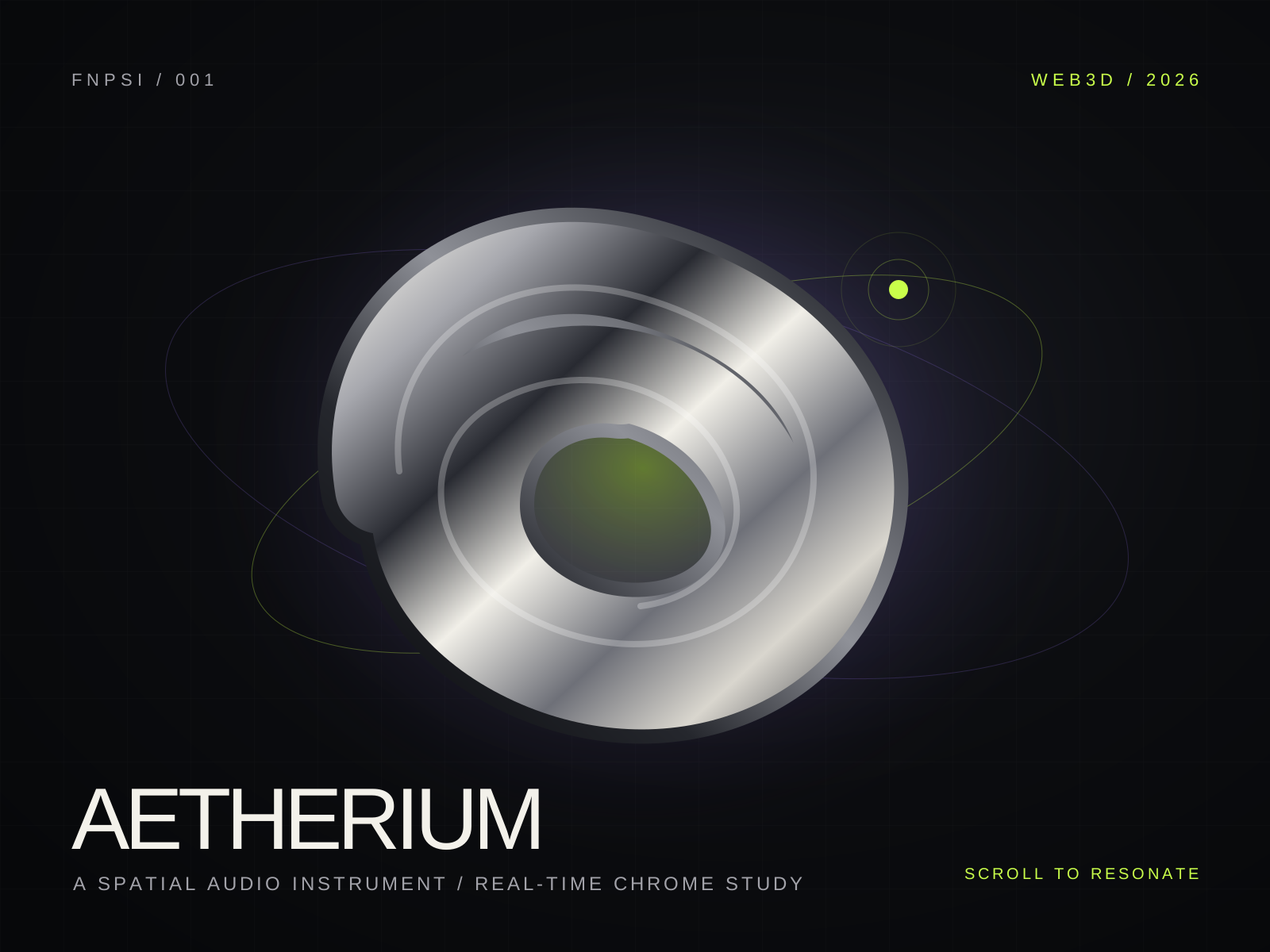
Aetherium started with a question: what does a sound look like before you hear it? The brief was self-set — design a product launch for an instrument that does not exist, and make the object itself the interface. No renders. No video. One WebGL scene that carries the whole story.
The product is a spatial-audio instrument with three adjustable frequencies. Instead of explaining it with a feature list, the page lets you feel the idea: a single chrome form that changes shape as the frequencies move.
02 / Approach
Treat the page as a score.
Each scroll segment moves the camera, changes the chrome's distortion, and brings a new frequency into the mix. A custom vertex displacement pass lets the form breathe without losing the hard reflections that make it feel manufactured.
The interaction is deliberately small: move, hold, listen, scroll. Nothing competes with the object. Typography sits at the edges like a control surface, and the chrome does the emotional work.
“The product is the page. The page is the product.”
03 / Build
A small system with a lot of surface.
The scene uses a high-resolution torus knot with a physical material and a procedural room environment for reflections. A lightweight Web Audio layer synthesizes three sine-based tones; the same values drive the object's scale, emissive rim, and orbital rings.
GSAP ScrollTrigger choreographs the camera and the DOM typography. On mobile the mesh density drops, the particle field halves, and audio stays opt-in. The scene pauses when it leaves the viewport or the tab is hidden.
- 01Real-time chrome material with iridescence and clearcoat reflections.
- 02Pointer parallax and scroll-driven camera choreography.
- 03Three synthesized frequency bands mapped to geometry and light.
- 04Reduced-motion and no-WebGL poster fallbacks.
AE
01
FREQ
03
SCROLL
SCORE
04 / Outcome
What it leaves behind.
The study ends with a simple test: can a product page make you understand a sound before you hear it? The chrome is the argument. The next step would be a real audio engine, a launch film, and a version that lets visitors play the three frequencies themselves.